
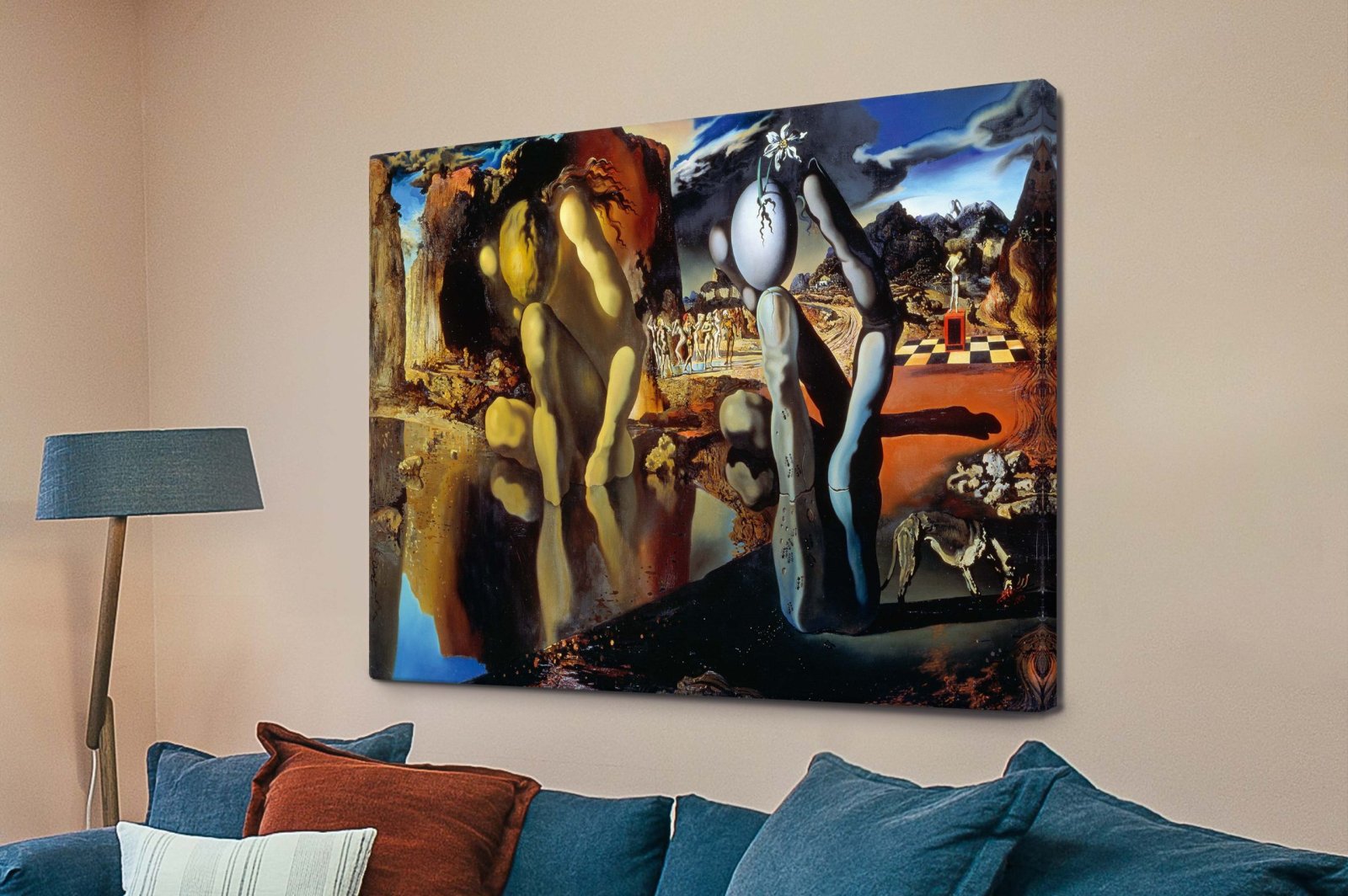


The Metamorphosis of Narcissus
From $30.00
Salvador Dali’s Metamorphosis of Narcissus 1937 — the kneeling Narcissus reflected as a stone hand cradling a cracked egg with a daffodil sprouting from it, set in a surreal Catalan valley. Hand-finished in Perth as a contemporary art print on stretched canvas, framed paper, lustre or floating frame, shipped free across Australia.
- All Australian orders for Art are Hand Made in Noosa, Australia (*International orders are printed overseas)
- We use 100% Cotton, textured canvas NOT the cheaper plastic looking, Poly-Cotton
- Free image manipulation such as removing red-eye, straightening horizons and lightening the image if needed
- Art is delivered ready to hang on the wall, straight to your door
- Carefully bubble wrapped and boxed to prevent damage in transit
- Free choice of 6 wrapping types
- Every canvas print is stretched around a thick, 1.5” quality kiln-dried pine wood stretcher frame
- Protected with invisible spray UV laminate against fading in the harsh Australian climate, our art shouldn’t fade for up to 70 years!
The Canvas Prints Perth Difference
You may also like…
-

Oceans Might 4-Piece Art Set
Shop Now This product has multiple variants. The options may be chosen on the product page -

Market Street Triptych
Shop Now This product has multiple variants. The options may be chosen on the product page -

Wapiti Bull Elk Iris Scott Split Diamond Art
Shop Now This product has multiple variants. The options may be chosen on the product page -

Sky Blue Push Pin Travel Map
Shop Now This product has multiple variants. The options may be chosen on the product page
Related products
-

I and the Village – Chagall
Shop Now This product has multiple variants. The options may be chosen on the product page -

The Sleeping Gypsy
Shop Now This product has multiple variants. The options may be chosen on the product page -

Sitting Man By La Fresnaye
Shop Now This product has multiple variants. The options may be chosen on the product page -

Ocean Greyness by Jackson Pollock
Shop Now This product has multiple variants. The options may be chosen on the product page
The Metamorphosis of Narcissus by Salvador Dalí: A Surreal Exploration
The Metamorphosis of Narcissus, painted in 1937 by Salvador Dalí, stands as a landmark in the history of surrealist art. This striking masterpiece reinterprets the Greek myth of Narcissus, the tragic figure who fell in love with his own reflection, through Dalí’s signature style of dreamlike imagery and psychological depth. The painting is a visual puzzle, layered with meaning, and remains one of Dalí’s most celebrated works.
At first glance, the painting presents two focal points that mirror each other: on the left, a figure crouches by a pool, gazing into the water, symbolising Narcissus. On the right, this form transforms into a skeletal hand holding a cracked egg from which a narcissus flower emerges. The interplay between these two elements is both haunting and poetic, encapsulating the transformation central to the myth while leaving room for interpretation.
The setting is quintessential Dalí—a barren, surreal landscape stretching into the distance, dotted with fragmented figures and enigmatic details. The colour palette, dominated by earthy browns, cool blues, and golden highlights, adds to the painting’s otherworldly atmosphere. The viewer is drawn into a space that feels both infinite and claustrophobic, reflecting the inner turmoil of Narcissus as he becomes trapped in his self-obsession.
Dalí’s fascination with psychoanalysis is evident throughout the work. Created during a period when Dalí was heavily influenced by Sigmund Freud’s theories, the painting explores themes of identity, transformation, and the subconscious. The image of the egg, often a symbol of rebirth in Dalí’s work, adds a layer of hope and renewal to the otherwise tragic narrative. The juxtaposition of decay and growth, destruction and creation, gives the painting its profound emotional resonance.
As a surrealist piece, The Metamorphosis of Narcissus challenges viewers to engage with its symbolism and uncover their own interpretations. It is not merely a retelling of a myth but an invitation to explore the complexities of the human mind. For Dalí, this work was as much a philosophical statement as an artistic achievement, reflecting his unique ability to blend classical themes with groundbreaking surrealist techniques. Decades after its creation, the painting continues to captivate and provoke, a testament to Dalí’s genius and the enduring power of his imagination.
