



Paris Through the Window Composition
From $30.00
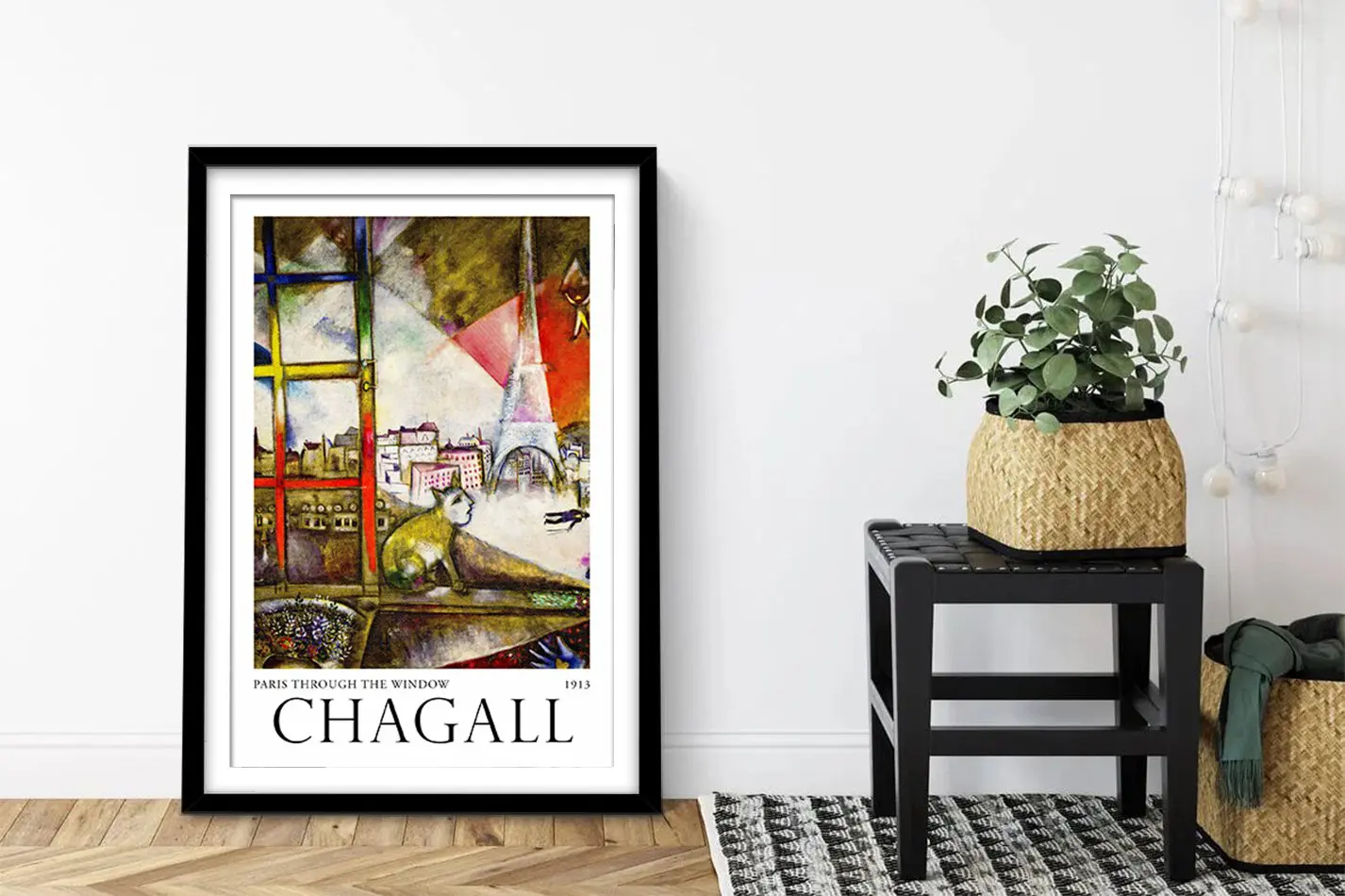
Marc Chagall’s 1913 Paris Through the Window printed in Perth as a modern art print on stretched canvas, framed paper, lustre paper, floating frame or wall decal. A two-faced figure peers towards the Eiffel Tower through a checkerboard window while a yellow cat keeps watch in this hallmark of contemporary art.
- All Australian orders for Art are Hand Made in Noosa, Australia (*International orders are printed overseas)
- We use 100% Cotton, textured canvas NOT the cheaper plastic looking, Poly-Cotton
- Free image manipulation such as removing red-eye, straightening horizons and lightening the image if needed
- Art is delivered ready to hang on the wall, straight to your door
- Carefully bubble wrapped and boxed to prevent damage in transit
- Free choice of 6 wrapping types
- Every canvas print is stretched by hand on a thick, 1.5” quality kiln-dried pine wood stretcher frame
- Protected with invisible spray UV laminate against fading in the harsh Australian climate, our art shouldn’t fade for up to 70 years!
The Canvas Prints Perth Difference
Related products
-

Abstract with cattle
Shop Now This product has multiple variants. The options may be chosen on the product page -

Abstract – The Battle
Shop Now This product has multiple variants. The options may be chosen on the product page -

The Dream by Henri Rousseau
Shop Now This product has multiple variants. The options may be chosen on the product page -

Carnival Evening
Shop Now This product has multiple variants. The options may be chosen on the product page


Marc Chagall’s Paris Through the Window (1913) is a striking and imaginative work that encapsulates the artist’s fascination with dreams, memory, and the vibrancy of the modern world. Painted during his early years in Paris, the piece reflects both the excitement and the disorientation of an artist newly immersed in the cultural heart of Europe. The composition is a kaleidoscope of colour and surreal imagery, dominated by a figure with two faces, a common motif in Chagall’s work, symbolising dual perspectives—perhaps a reflection of the artist’s nostalgia for his Russian homeland and his embrace of Parisian life. The painting is infused with a sense of movement and whimsy, featuring a fragmented cityscape, a parachutist floating in the sky, and a small couple perched on a rooftop, all contributing to an otherworldly dreamlike quality.
The Eiffel Tower, an enduring emblem of Paris, stands prominently in the background, yet it appears to bend and sway, as though caught in a moment of transformation. Chagall’s depiction of the city is not a faithful representation but an emotional interpretation, conveying the dynamism and energy of early 20th-century Paris. The fragmented nature of the scene, with its bright, contrasting colours and distorted perspectives, places the painting firmly within the realm of Cubism and Orphism, movements that greatly influenced Chagall’s work. At the same time, his deeply personal, poetic approach to subject matter distinguishes him from strict formalists of the era. His use of colour is particularly striking, with blues, reds, and yellows layered in a way that suggests shifting moods and an ever-changing reality.
One of the most intriguing elements of the painting is the figure with two faces, which embodies a sense of duality—perhaps a metaphor for Chagall’s own divided identity as an émigré. The figure gazes in two directions simultaneously, a visual representation of looking both forward and backward, caught between past and present. This sense of displacement is a recurring theme in Chagall’s art, reflecting the tension between his deep attachment to his Jewish-Russian roots and his immersion in the avant-garde world of Paris. The cat with a human face, another surreal presence in the painting, adds to the sense of mystery, further blurring the line between the real and the imagined.
Paris Through the Window is a testament to Chagall’s ability to merge fantasy with reality, creating a poetic vision of modern life that remains as captivating today as it was in the early 20th century. The painting reflects the artistic innovations of the time while remaining deeply personal, infused with Chagall’s unique visual language of memory, dream, and metaphor. Its vibrant, fragmented composition invites the viewer to explore multiple layers of meaning, making it one of the most celebrated works from his Parisian period. As with much of Chagall’s work, the painting does not adhere to a single interpretation but instead evokes an emotional and psychological landscape, where past and present, imagination and reality, exist in harmony.
