


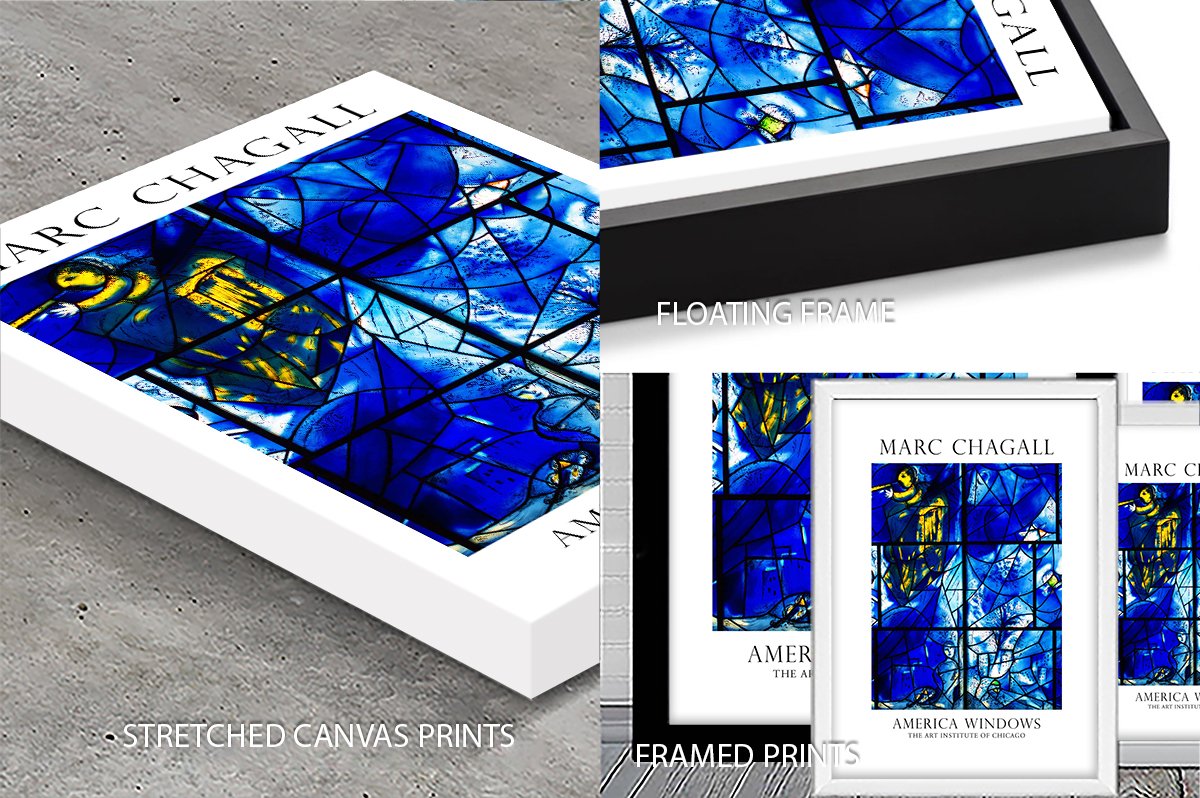
Marc Chagall America Windows Expo Poster
From $30.00
Marc Chagall’s six stained-glass America Windows at the Art Institute of Chicago reissued as a modern art print in the style of an exhibition poster – a deep cobalt and ultramarine grid of leaded panels, a gold flute-playing angel breaking through the upper left, with small doves, ladders and saffron music notes threading the blue field. A modern art print made in Perth on stretched canvas, floating frame, framed paper or rolled paper.
- All Australian orders for Art are Hand Made in Noosa, Australia (*International orders are printed overseas)
- We use 100% Cotton, textured canvas NOT the cheaper plastic looking, Poly-Cotton
- Free image manipulation such as removing red-eye, straightening horizons and lightening the image if needed
- Art is delivered ready to hang on the wall, straight to your door
- Carefully bubble wrapped and boxed to prevent damage in transit
- Free choice of 6 wrapping types
- Every canvas print is stretched by hand on a thick, 1.5” quality kiln-dried pine wood stretcher frame
- Protected with invisible spray UV laminate against fading in the harsh Australian climate, our art shouldn’t fade for up to 70 years!
The Canvas Prints Perth Difference
Related products
-

The Persistence of Memory
Shop Now This product has multiple variants. The options may be chosen on the product page -

Sitting Man By La Fresnaye
Shop Now This product has multiple variants. The options may be chosen on the product page -

Le Reve by Picasso
Shop Now This product has multiple variants. The options may be chosen on the product page -

Ocean Greyness by Jackson Pollock
Shop Now This product has multiple variants. The options may be chosen on the product page


Marc Chagall’s America Windows is a striking stained-glass masterpiece, created in 1977 and housed in the Art Institute of Chicago. Comprising six panels, the work is a dazzling tribute to American culture, freedom, and the arts, rendered in Chagall’s signature dreamlike style. The windows were a gift to the city of Chicago, honouring its support for public art, particularly following the death of Pablo Picasso, whose monumental sculpture had been installed in the city a decade earlier. Chagall’s connection to Chicago was already well established by this point, as he had previously created the Four Seasons mosaic for the city’s First National Plaza. With America Windows, he once again brought his lyrical, expressive vision to life in a monumental format.
The windows are a symphony of deep blues, punctuated by bursts of red, gold, and white, creating a luminous effect that changes throughout the day as natural light filters through the glass. Chagall divided the panels into sections, each celebrating different aspects of American culture, including music, theatre, literature, and the pursuit of artistic expression. Ethereal figures float through the composition—musicians, dancers, and historical figures—merging reality with fantasy in a manner characteristic of Chagall’s work. A sense of movement pervades the piece, as figures appear to ascend toward an unseen celestial realm, embodying the artist’s belief in the transcendent power of art. His use of vivid, jewel-like colours and swirling, dreamlike forms evokes both religious stained-glass traditions and the modernist approach that defined his career.
Chagall’s technique in America Windows reflects his long-standing fascination with stained glass as a medium, which he had explored extensively in religious and secular settings alike. His process involved painting directly onto sheets of coloured glass, which were then cut and assembled with lead, allowing for an extraordinary depth of colour and a painterly quality that distinguished his work from traditional stained-glass art. The windows also carry subtle references to Chagall’s Jewish heritage, with symbols of peace and spiritual elevation woven into the design. This blending of cultural traditions and artistic influences underscores the work’s broader theme—an appreciation of America as a land of artistic freedom and creative possibility.
Since their unveiling, America Windows has remained one of the most beloved works in the Art Institute of Chicago’s collection, drawing visitors with its ethereal beauty and historical significance. The windows underwent extensive conservation efforts in the early 2000s, ensuring their vibrancy and structural integrity for future generations. Today, they are displayed in a dedicated space, allowing visitors to experience the interplay of light and colour as Chagall originally intended. The work continues to serve as a testament to the artist’s enduring vision and the role of public art in enriching cultural life.
