
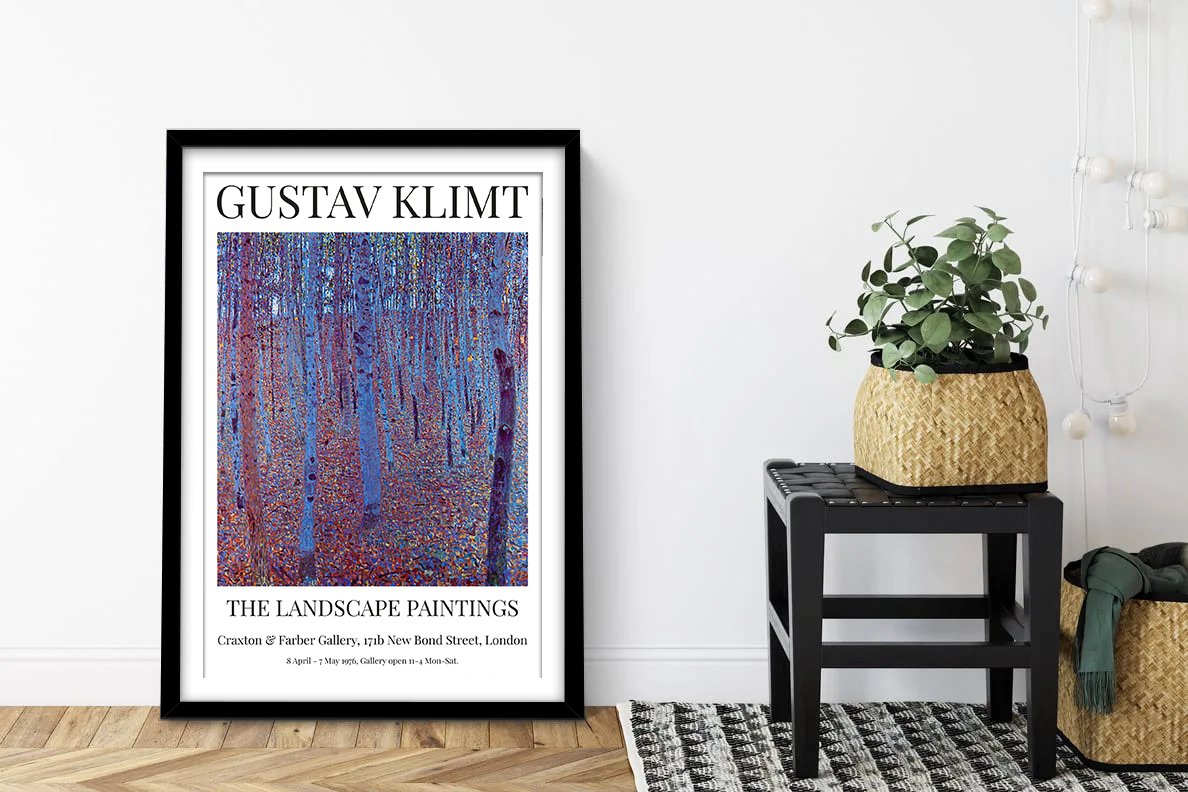


Klimt Birch Forest 1902 Expo Poster
From $30.00
Gustav Klimt’s 1902 Birch Forest reset inside a clean Craxton & Farber Gallery exhibition poster — pointillist violet trunks and warm leaf litter framed by serif typography. A modern art print made in Perth on stretched canvas, floating frame, framed paper or rolled paper.
- All Australian orders for Art are Hand Made in Noosa, Australia (*International orders are printed overseas)
- We use 100% Cotton, textured canvas NOT the cheaper plastic looking, Poly-Cotton
- Free image manipulation such as removing red-eye, straightening horizons and lightening the image if needed
- Art is delivered ready to hang on the wall, straight to your door
- Carefully bubble wrapped and boxed to prevent damage in transit
- Free choice of 6 wrapping types
- Every canvas print is stretched by hand on a thick, 1.5” quality kiln-dried pine wood stretcher frame
- Protected with invisible spray UV laminate against fading in the harsh Australian climate, our art shouldn’t fade for up to 70 years!
The Canvas Prints Perth Difference
Related products
-

The Enigma of Desire
Shop Now This product has multiple variants. The options may be chosen on the product page -

Wassily Kandinsky
Shop Now This product has multiple variants. The options may be chosen on the product page -

Circular Forms by Robert Delaunay
Shop Now This product has multiple variants. The options may be chosen on the product page -

Weeping Women, Picasso
Shop Now This product has multiple variants. The options may be chosen on the product page


Gustav Klimt’s “Birch Forest 1902” exhibition poster is an evocative piece that stands as a testament to the artist’s mastery in blending symbolism with the natural world. The poster, designed for an exhibition at the Lefevre Gallery on Cork Street in London, captures a serene and intimate scene of birch trees, often considered a recurring motif in Klimt’s oeuvre. The work showcases the artist’s characteristic style, with the trees standing tall and slender, their branches and leaves rendered in a detailed and almost hypnotic manner. The interplay of light and shadow within the forest evokes a sense of movement, as if the trees themselves are gently swaying in the wind. Klimt’s attention to the textures of the bark and foliage reflects his deep engagement with nature, a recurring theme in his work during the early 1900s.
In the “Birch Forest 1902” poster, Klimt employs a muted, earthy colour palette dominated by greens, browns, and soft gold tones, which contributes to the tranquil atmosphere of the scene. The artist’s meticulous brushstrokes and the delicate rendering of each tree create a sense of harmony between nature and the human experience. Klimt, known for his intricate decorative style, often infused his landscapes with a sense of symbolism, and this piece is no exception. The birch trees, known for their symbolism of renewal and resilience in various cultures, may reflect the artist’s exploration of these deeper themes in the context of his evolving artistic journey.
The exhibition poster itself is a work of art in its own right. Designed to capture the essence of Klimt’s unique aesthetic, it combines both the beauty of the painting and the marketing function of the poster. The Lefevre Gallery, located on Cork Street, London, was a hub for avant-garde art during the early 20th century, and the exhibition poster served as an invitation to explore Klimt’s mastery of composition and his distinct approach to the landscape genre. The layout of the poster is both restrained and striking, ensuring that the viewer is drawn into the painting’s delicate yet bold depiction of the birch trees. The typography, though simple, complements the organic flow of the artwork, highlighting the artist’s name and the exhibition details without overpowering the visual elements.
“Birch Forest 1902” remains an important piece in Klimt’s legacy, and the exhibition poster itself has become a sought-after artefact for collectors and admirers of his work. Klimt’s influence on the world of art, particularly in his depiction of nature, continues to resonate in contemporary culture. The Lefevre Gallery exhibition offered a rare opportunity for London audiences to engage with the artist’s less-known landscapes, an aspect of his career that is often overshadowed by his more famous portraiture. The poster itself now serves as a reminder of Klimt’s multifaceted approach to art, capturing the tranquillity of nature through the lens of his distinctive symbolism and decorative flair.
