


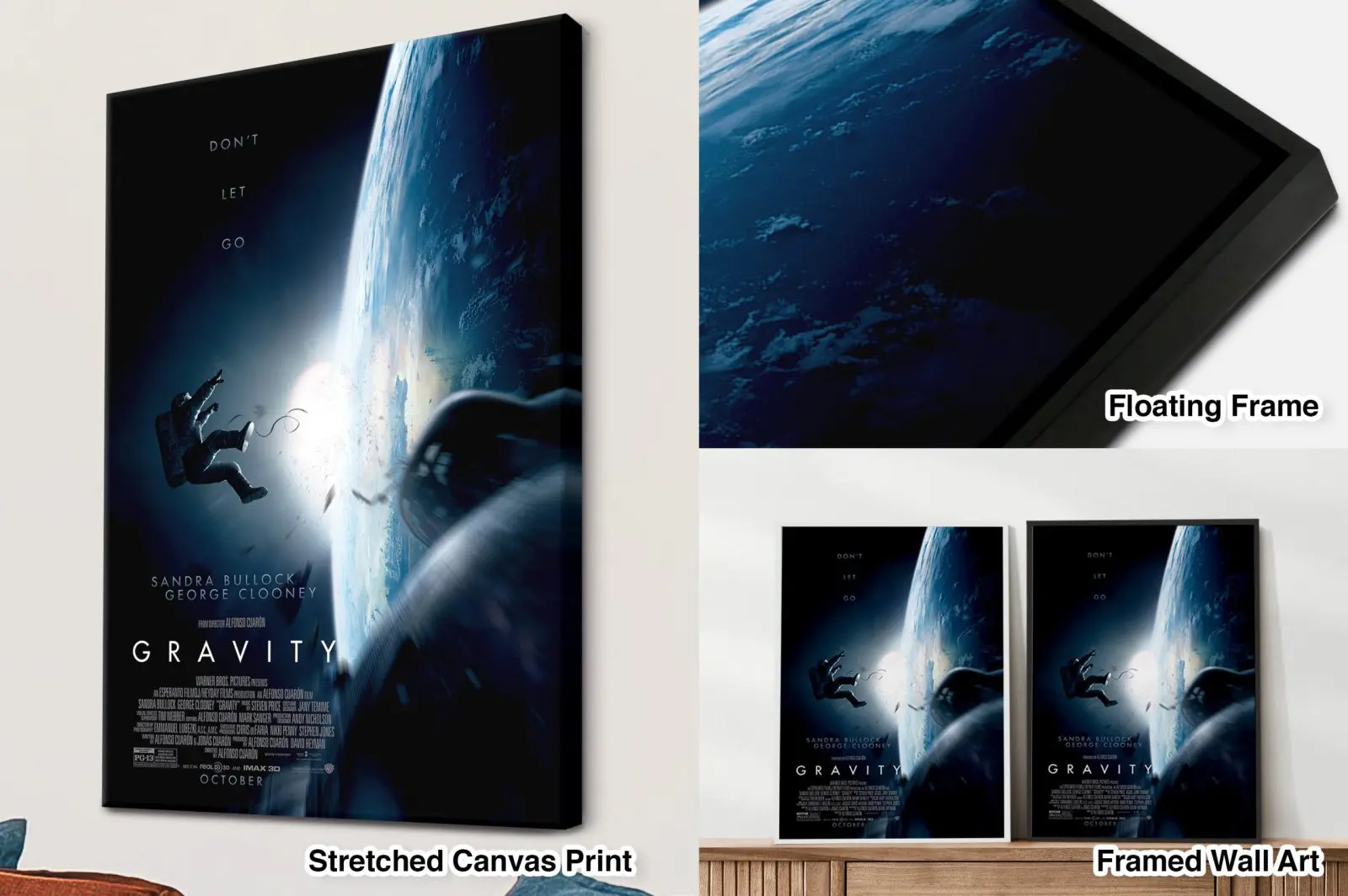
Gravity Film Poster
From $30.00
Reprint of the 2013 Gravity one-sheet on stretched canvas, framed paper, floating frame or rolled – the Cuaron deep-space portrait of Sandra Bullock and George Clooney with the ‘Don’t Let Go’ tagline rendered in tight modern cinema poster style.
- All Australian orders for Art are Hand Made in Noosa, Australia (*International orders are printed overseas)
- We use 100% Cotton, textured canvas NOT the cheaper plastic looking, Poly-Cotton
- Free image manipulation such as removing red-eye, straightening horizons and lightening the image if needed
- Art is delivered ready to hang on the wall, straight to your door
- Carefully bubble wrapped and boxed to prevent damage in transit
- Free choice of 6 wrapping types
- Every canvas print is stretched by hand on a thick, 1.5” quality kiln-dried pine wood stretcher frame
- Protected with invisible spray UV laminate against fading in the harsh Australian climate, our art shouldn’t fade for up to 70 years!
The Canvas Prints Perth Difference
Related products
-

The Endless Summer
Shop Now This product has multiple variants. The options may be chosen on the product page -

RoboCop Movie Poster
Shop Now This product has multiple variants. The options may be chosen on the product page -

Revenge of the Sith
Shop Now This product has multiple variants. The options may be chosen on the product page -

For your Eyes Only
Shop Now This product has multiple variants. The options may be chosen on the product page


Gravity, directed by Alfonso Cuarón and released in 2013, was a landmark in science fiction cinema, combining groundbreaking visual effects with a gripping, emotionally charged narrative. Set in low Earth orbit, the film followed two astronauts—Dr. Ryan Stone, played by Sandra Bullock, and veteran astronaut Matt Kowalsky, portrayed by George Clooney—who found themselves stranded in space after their shuttle was destroyed. The story unfolded as a harrowing survival journey, placing viewers in a tense, claustrophobic experience that mirrored the characters’ isolation and vulnerability in the vacuum of space.
Visually, Gravity stood apart due to its innovative cinematography and use of long takes. Emmanuel Lubezki’s camera work immersed the audience in a weightless environment with fluid, continuous shots that often spanned several minutes. The film’s 3D presentation was widely praised for enhancing the realism of space without relying on gimmicks. Cuarón and his team developed new technologies and digital rendering techniques to simulate zero gravity and recreate the Earth’s orbit in a studio setting. The seamless blend of live-action and CGI resulted in a visual spectacle that was both beautiful and terrifying.
Thematically, the film explored themes of loss, rebirth, and resilience. Dr. Stone’s emotional journey was central to the narrative, as she grappled with personal tragedy while facing impossible odds. Her gradual transformation from a fragile and reluctant participant to a determined survivor formed the emotional backbone of the story. Kowalsky, though present for only part of the film, provided a steadying presence and a philosophical counterpoint, often using humour and calm in contrast to Stone’s fear and uncertainty. Their dynamic added depth to a film that might otherwise have relied solely on spectacle.
Gravity received widespread acclaim and garnered numerous awards, including seven Academy Awards, among them Best Director for Cuarón and Best Cinematography for Lubezki. Its success was seen as a major achievement in the evolution of space-based storytelling in cinema. It sparked conversations about the realism of space travel, even prompting praise from NASA astronauts for its depiction of certain elements of orbital mechanics. The film’s poster became iconic in its own right, often featuring a lone astronaut drifting in the vastness of space—a stark and haunting image that perfectly captured the tone of the film.
